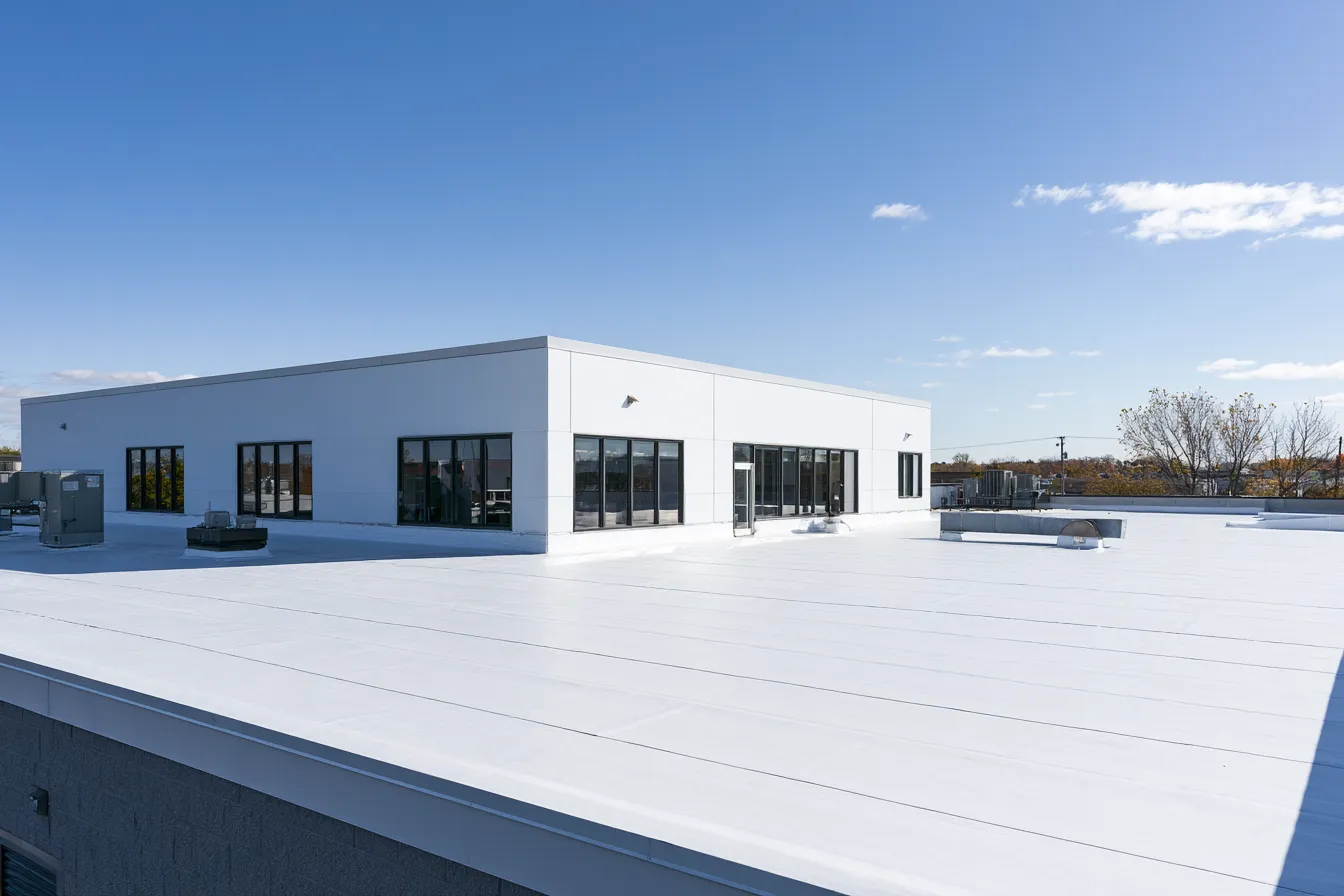
Commercial Roofing in Murphy, TX
On a commercial building the expensive half of a leak sits underneath the deck.
You've got stock on the floor and water coming in. Our roofers survey the underside first, then phase the work around your hours.
Commercial roofs around Murphy in Collin County
Repair the area, or replace the roof? What sits under it moves that answer further than the membrane does, so tell Murphy Roofing Company what the space is used for before you describe the roof. Say what the building is and what you're seeing on it, and you haven't committed to a thing.
That's why one hole prices two ways. Over a warehouse aisle it's roof work. Over a leased suite it's roof work plus fit-out, stock and whoever the lease says carries the loss, and that last part is usually settled long before anybody calls a roofer.
Which Murphy roofs this page covers
Retail units, office suites and light industrial space are what this covers, along with the mixed-use buildings that carry a bit of both. A survey on any of them starts with the use of the space and works up to the membrane, since what's stored or staffed below sets the order everything else happens in.
The use of the space, first
What is stocked, staffed or stored under each area is established before the membrane goes down. It's what decides which part of the roof can wait and which part can't.
The existing system identified
TPO, EPDM, modified bitumen and coatings each fail in their own way and repair on their own terms. What's already up there is confirmed before a price goes near it.
Drainage read as one system
Internal drains, scuppers and overflow paths get checked together instead of one at a time. Most low-slope failures turn out to be drainage failures wearing another name.
Curbs and penetrations counted
Rooftop units, vents and curbs are where these roofs let go, so they get counted and listed as their own lines. A single flat number for the whole area has skipped the part that leaks.
Access and hours settled up front
When work can happen on an occupied building is agreed before the first day on site. Loading, parking and roof access come in the same conversation.
Two warranties, two documents
The membrane warranty comes from the manufacturer, and our roofers put their own workmanship terms in writing beside it. Both are named on the estimate, so what's covered by each of them is settled before anything starts.
TPO, EPDM and bitumen on a Murphy roof
Three systems cover most of what's up there on buildings this size, and the building itself usually decides between them before anyone's preference does. What separates them in practice is below.
| What varies on the building | What that points to |
|---|---|
| Foot traffic | A roof crossed every week by engineers servicing plant takes wear that a roof nobody walks never sees. Multi-layer modified bitumen carries that traffic; single-ply suits the roof left alone. |
| Cooling load | A light-colored single-ply throws heat back instead of holding it, which shows up on the bill for a cooled retail box and barely registers on an unconditioned warehouse. |
| Roof shape | Large open areas suit welded single-ply, where the seams run long and straight. Roofs cut up with units, ducts and hatches favor a system that details easily around obstructions. |
| What is already up there | The existing deck and any substrate worth keeping narrow the field before preference gets a say. A survey settles that before anyone names a system. |
Working around an open Murphy building
The building keeps trading while the roof comes off, so the work arrives in stages that can stop and restart. That one constraint sets the order of everything below.
The roof and the rooms under it
Membrane condition and the details it turns on, and separately what sits beneath each area: stock, staff, plant, server rooms. The second list is what sets the order of the first.
The lease position
Who carries what, and who has to be told in advance. On a tenanted building that shapes the schedule as much as the roof does.
One area at a time
Phases get sized around how much can be opened and made watertight again in one go. An open low-slope deck and a night of rain do not mix, so the phase count follows that limit more than it follows the square footage.
Stripped, detailed, closed
Each phase comes off, gets detailed around its curbs and drains, and goes back down. Drains stay live the whole way, since a half-finished roof still has to take rain.
With the paperwork
As-built detail of what went on, a record of what was found underneath, and the workmanship terms from our roofers alongside the manufacturer's document. That paperwork goes to the building owner at handover.
What building owners here ask us
Have a Murphy commercial roof assessed
Send the building type and what sits under each part of the roof. Our roofers walk it before there's any talk of cost.